Book Review: Out of My Skull (The Psychology of Boredom)
Core Insights
A susceptibility to boredom is an inherent trait of humanity—and perhaps all living creatures—because boredom itself is a 'call to action.' As biological entities, action is our indispensable element; thus, boredom can be viewed neutrally as a biological mechanism that triggers behavior. Experiencing boredom is rarely pleasant. That sensation of having a surplus of cognitive resources with nowhere to anchor them often evokes memories of our school days—possessing boundless energy yet forced to remain seated, listening to a teacher's lecture. Boredom is like a piece of encrypted code from the depths of our psyche. Upon further decoding, one realizes that boredom is not inherently harmful; rather, what is harmful are the reactive behaviors we adopt to escape the negative emotions it stirs. This book helps us 'decode' boredom, allowing us to deconstruct the negative affect it triggers and dissolve the common stigma surrounding it. Ultimately, it enables boredom to serve as a catalyst for positive action, allowing us to take mastery over our own lives.
Key Quotes and Reflections
Schopenhauer: 'The fundamental reality of the world manifests most directly in our own experience of desire.' In other words, life is desire, struggle, and longing. If life is a ceaseless yearning, then the desires we harbor can never be fully satisfied... Happiness is forever in a state of 'about to arrive.' The moment it settles, a new desire immediately takes its place. According to Schopenhauer, we are destined to suffer for long durations because the desires in our hearts flow like a river that never stops. We are faced with two tragic options: the pain of unfulfilled desire, or the boredom of having nothing to desire.
Chapter Framework
Analysis of the book's structure is as follows: 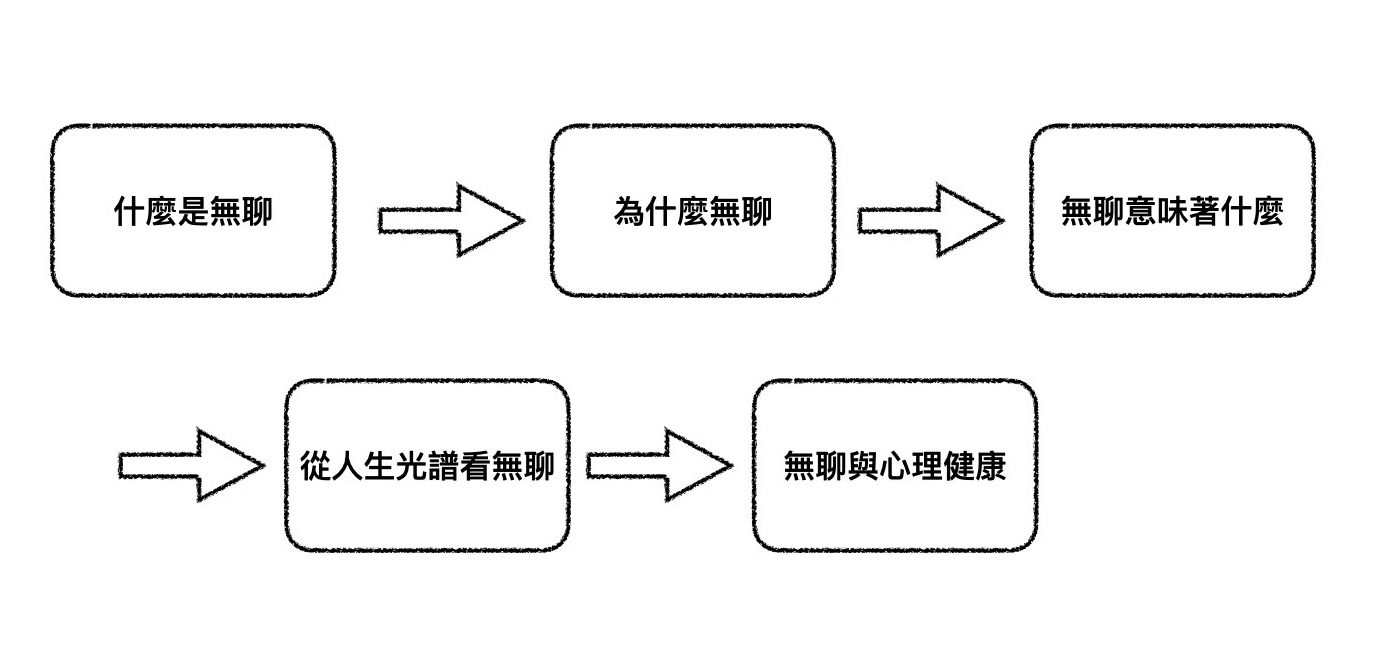
Looking at the book as a whole, its core is singular: it is an exploration of 'Boredom.' To put it in a nutshell, using the book's description: 'Boredom is an undefined, directionless yearning.' In truth, if one looks back at how Schopenhauer discussed boredom, it is not hard to see that the author’s interpretation differs slightly. Yet, we generally agree that boredom is a state of restless dissatisfaction with the status quo. The author cites various perspectives, cutting into boredom from multiple angles: Existentialism links boredom with the meaning of life; Neuroscience dissects it through the relationship between specific brain regions and the Default Mode Network (DMN); and Phenomenology, inevitably, uses intentionality and time as the foundation for its discourse.
As a psychology student who loves literature and philosophy and has undergone neuroscientific training, I found this book exceptionally resonant. The author strikes a perfect balance; while the various perspectives mentioned are only touched upon at the surface level, had he gone any deeper, readers might have shelved the book out of sheer boredom before even learning why they were bored!
Returning to the narrative structure: once the question of 'What is boredom?' is resolved, everything thereafter becomes clear. Once we understand that boredom is a universal human (and even biological) phenomenon, signifying merely our dissatisfaction with our current environment, we can view our boredom objectively and positively. This grants us the 'space' to detach from ourselves and observe the matter from a more macroscopic perspective—viewing boredom through the lenses of social order, life development, or even extreme environments.
Summary
Echoing the final sections of the book and reflecting on our environment, there is one point worth keeping close to heart: '...So, information overload is ultimately boring, and what the internet and smartphones provide is merely a simulacrum of our desire to be engaged in something.' One suddenly wakes up to find they have been scrolling through their phone for over half an hour, accompanied by a complex swirl of emotions—annoyance, anxiety, regret—but rarely joy or delight. I believe this is a common experience for many modern people; more precisely, it may be the 'repetitive' daily reality we all share. Today, we can easily dispel boredom through our phones and social media, but returning to the phrase 'a simulacrum of the desire to engage': our measures for handling boredom may be treacherous. While the debate over what constitutes 'reality' versus 'illusion' is a separate battlefield, objective evidence repeatedly tells us that the 'virtual world' brings numerous negative impacts.
As a call to action, boredom—to put it grandiosely—may be a major driver of the splendors of human civilization. Whether boredom is a blessing or a curse depends on the kind of life we wish to lead. One needn't necessarily harbor soaring ambitions, but simply by remaining awake and aware—understanding exactly which behaviors our 'boredom' is triggering—we can lead a more grounded and joyful life.
The Existentialist Perspective
An existentialist view holds that when we realize we are the masters of our own lives, we feel a lingering, unshakeable anxiety, for this awakening is overwhelming. Emotional numbness, and the boredom that follows, may precisely be a reaction to this anxiety. If we can find external standards to live by, or attribute our internal conflicts to external factors rather than taking life entirely into our own hands, we might live much more easily.
Any theme involving self-exploration, like 'Boredom,' inevitably drifts into Existentialism. This passage left me in deep thought. In The Denial of Death, Ernest Becker noted that humans worship heroes and yearn for someone else to take responsibility for their lives. Becker explores this through the psychological mechanism of attempting to flee from death—a brilliant analysis. In the decade since I first encountered this discourse, various social events have repeatedly reinforced my admiration for his insights. While Becker focuses on the origins of anxiety and behavior, The Psychology of Boredom focuses on the adaptive behaviors humans develop in response to that anxiety. Though the focal points differ, I feel a quiet realization: the 'Great Way' is simple (Dà dào zhì jiǎn), yet the mysteries of the universe leave us like the blind men touching the elephant—trying to piece together the image of the whole from exquisite descriptions of its disparate parts.
Thank you for reading. If you enjoyed this post, consider sharing it with others.